Each Paris Fashion Week session brings together two worlds. On one hand, there are the presentations of the official calendar of the Fédération de la Haute Couture et de la Mode, reserved for the houses listed there. On the other, a much larger ecosystem of free formats—showrooms, collection presentations, press days, and pop-ups—open to all brands without any accreditation. It is in this second world that the bulk of the commercial activity of Fashion Week takes place, and it is this world that fills the spaces of the Marais district each week. Understanding how each format works, its specific objectives, and how to combine them within the same week allows you to build an effective Parisian presence, regardless of your brand's stage of development. This guide reviews the four main free formats and helps you choose the one that's right for you. For complete integration with the Fashion Week schedule, see our main page.
Summary
Being outside the official schedule doesn't mean being out of the game.
Let's first clarify a point that unnecessarily worries many young brands. The official calendar of the Fédération de la Haute Couture et de la Mode (Fédération de la Haute Couture et de la Mode) structures the major dates of the sessions: Women's Spring/Summer 2027 from September 28 to October 6, 2026; Men's Autumn/Winter from January 19 to 24, 2027; Haute Couture from January 25 to 28, 2027; and Women's Autumn/Winter from March 1 to 9, 2027. However, being included in this calendar is by no means a prerequisite for participating in the sessions. Buyers and journalists actually spend the majority of their time in Paris in showrooms and at open appointments, as this is where orders are placed and new brands are discovered. Organizing your own event during the session dates simply means positioning yourself when the entire industry is in Paris, with your own invitations, your own venue, and your own schedule. No authorization, no selection process, no accreditation is required. The only barrier to entry is the quality of your project and your space.
The buying showroom, the commercial backbone of the week
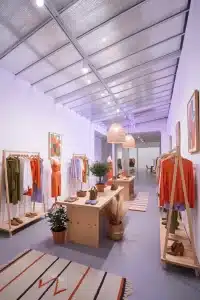
The showroom is the most widespread and directly profitable format. Its principle is simple. The brand sets up its collection on racks in a dedicated space and receives buyers by individual appointment, generally forty-five minutes, throughout the session and often a few days before and after. The goal is to secure orders for the following season. The showroom requires a central location, as buyers group their appointments by neighborhood; accurate lighting to judge colors and fabrics; clear racks; and a functional ordering table. Its duration varies from a few days to two full weeks. This format best justifies a careful investment, as each successful appointment potentially translates into an order book. Spaces in the Marais district, ranging from twenty-five to several hundred square meters, precisely meet this need, as detailed in our comprehensive guide.

The collection presentation, the image format par excellence
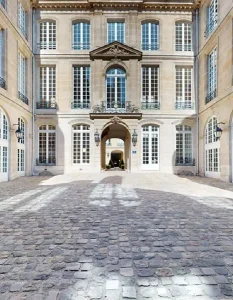
The collection presentation serves a different purpose. It's no longer about selling individual pieces, but about bringing the brand's universe to life for the press, buyers, and key influencers. The principle involves showcasing the collection on live models or mannequins, within a carefully designed setting, during a short window of two to four hours where guests can move freely. This format offers complete creative freedom—music, installations, performances—while remaining far more accessible than an event on the official calendar. It requires a venue with a strong character, as the decor plays a crucial role in conveying the message. The private mansions of the Marais district lend themselves remarkably well to this, such as the Hôtel de Montmort at 79 rue du Temple, a 17th-century building, or the Hôtel Le Lièvre de la Grange at 4 rue de Braque, a listed historical monument since 1953 with its Rococo decor. A successful presentation generates images that fuel the brand's communication throughout the season.
Press day, the meeting place for editors and stylists
The press day targets a specific audience: journalists, editorial stylists, and PR managers. The brand, or more often its press agency, showcases the collection in a welcoming space and hosts media outlets for one or two days, on a rolling basis rather than by strict appointment. The goal is product placement: to get the pieces borrowed for editorial photoshoots and featured in fashion pages. The press day requires a more relaxed atmosphere than a buying showroom, with a convivial space, a well-appointed café, and accessible pieces that can be handled, photographed, and reserved. Many agencies share a press day for several brands, allowing emerging labels to access media outlets they wouldn't reach on their own. The haute couture season at the end of January and the days following each show are particularly sought-after for this format.

The pop-up, when the session meets the final audience
The pop-up adds a dimension that other formats lack: direct sales to the public. During Fashion Week, the Marais district sees an influx of international fashion enthusiasts, and a well-located pop-up shop captures this flow while also benefiting from the week's media exposure. A pop-up can sell a dedicated capsule collection, test a market before a permanent location, or extend the impact of a presentation with an experience open to everyone. It requires a ground-floor space with a storefront, a functional retail layout, and extended opening hours. Its duration is more flexible than other formats, ranging from a few days to several weeks, allowing it to extend beyond the official dates of the event. The street-facing glass-fronted spaces in the Galerie Joseph park, particularly on Rue de Turenne and Rue Charlot, meet this visibility requirement. Our Fashion Week page presents all the possible event configurations.

Combining formats in the same week: scenarios that work
The true power of these flexible formats lies in their combination. A classic scenario involves opening the session with a collection presentation at the beginning of the week, creating a buzz and generating buzz, followed by a buying showroom that capitalizes on this exposure to fill appointment books. Another scenario combines a weekday showroom with a continuous pop-up, the temporary boutique serving as a public showcase while business is conducted by appointment. Brands working with a press agency often add a press day alongside the session. These combinations can take place in a single large, zoned space, or in two spaces close to each other in the same neighborhood, which is facilitated by the density of the Galerie Joseph complex in the 3rd arrondissement, with more than thirty spaces spread across a few streets. A dedicated manager then coordinates the transitions, nighttime setup between sequences, flow management, and cleanup.
Which format should you choose depending on your objective?
The choice boils down to an honest question about the season's priorities. If the goal is wholesale sales, a buying showroom is essential and deserves the bulk of the budget. If the brand's primary focus is building brand awareness with the press and buyers, a collection presentation or press day offers the best return on investment. If the objective is to meet the end customer and finalize retail pricing, a pop-up provides concrete solutions in just a few days. Growing brands gradually combine these elements over the seasons, often starting with a small shared showroom before expanding the operation. In all cases, the location is crucial. A prime location in the Marais district, a space suited to the format, and reliable technical support transform a good intention into a successful professional event. Galerie Joseph offers spaces ranging from 25 to 1,200 square meters, with capacities from 50 to over 700 people, and provides quotes within 24 hours.
FAQ
Do you need accreditation to organize an event during Paris Fashion Week?
No. Showrooms, collection presentations, press days, and pop-ups are entirely flexible formats. Only presentations on the official calendar fall under the jurisdiction of the Fédération de la Haute Couture et de la Mode. You rent a space, invite your contacts, and set your own schedule during the session dates.
What is the difference between a showroom and a collection presentation?
The showroom is a multi-day commercial event where buyers come by individual appointment to place orders for the following season. The collection presentation is a shorter, two- to four-hour format where the collection is showcased in front of press and guests to establish the brand's identity. The two are often combined within the same week.
Can multiple formats be organized in the same space?
Yes, provided you choose a sufficiently large or adaptable space and plan the transitions. A large stage can host an evening presentation and then be reconfigured into a showroom the very next day. The dedicated Galerie Joseph stage manager coordinates these transitions, including nighttime setup, to ensure that each sequence begins in a pristine space.
Conclusion: your Parisian presence is built with complete freedom
Paris Fashion Week also belongs to brands not listed on the official calendar. Buying showrooms, collection presentations, press days, and pop-ups form a comprehensive toolkit, without accreditation or entry barriers, where each format serves a specific purpose and where combinations multiply results. The starting point remains the same: a well-positioned space at the heart of the buyer and press circuit. Galerie Joseph offers you more than thirty exclusive spaces in the Marais district, from bright studios to listed private mansions, with a dedicated manager and a response to your quote request within 24 hours. Contact our team at +33 (0)1 42 71 20 22, including for remote selection, and find all the keys to a successful session in our guide.
Are you looking for an unusual place in Paris?
Discover the Galerie Joseph spaces in the Marais and find a venue suitable for your launch, showroom, exhibition, pop-up store or private event.